Thursday, November 8, 2018

MODE at the River District

MODE by Wesgroup is a brand new addition to South Vancouver’s 130-acre River District. Set alongside Vancouver’s waterfront, this project features 1, 2 or 3 bedroom homes, townhouses, and live-work homes. MODE is centrally located by the Town Centre Plaza, just steps away to banks, cafes, restaurants, a grocery store and more. This project brings modern design and features to 25 acres of greenspace, abundant indoor and outdoor entertainment features, giving you the comfort of West Coast Living with a contemporary feel. MODE is superbly located, just 10 minutes to Richmond, 13 minutes to Marine Gateway, and 20 minutes to YVR. 

The post MODE at the River District appeared first on Vancouver New Condos.


from Projects – Vancouver New Condos https://ift.tt/2QvUZyg

Urbana at Central Green

Urbana at Central Green by Mission Group is a new residence with 55 modern studio to three bedroom homes in the heart of Downtown Kelowna. Urbana is part of Central Green, a residential master-planned community at Harvey Avenue and Richter Street, just minutes away from Pandosy Village. Experience living steps to beaches, shopping, dining and a 5-acre park. Urbana brings heritage-inspired modern homes to a neighbourhood rich with history.

The post Urbana at Central Green appeared first on Vancouver New Condos.


from Projects – Vancouver New Condos https://ift.tt/2DaxbvS

Tuesday, November 6, 2018

Fever and the Nature of Acute Disease

The following excerpt is from Dr. Cowan’s book Vaccines, Autoimmunity, and the Changing Nature of Childhood Illness, and is reprinted with permission from the publisher.

In November 1890, a twenty-eight-year-old surgeon named William Coley amputated the forearm of a young woman named Bessie Dashiell. A dear friend of John D. Rockefeller Jr., Dashiell was afflicted with a malignant bone tumor in her hand. Coley had recently joined the staff of New York City’s Memorial Hospital to work under the tutelage of Dr. James Ewing, a revered sarcoma specialist, and Memorial was considered the foremost sarcoma treatment center in the world. Nevertheless, Dashiell’s cancer persisted and spread throughout her body, killing the young woman in a matter of weeks.1

Shaken by Dashiell’s death and what seemed like Memorial’s far too frequent failures to treat sarcoma successfully with their advanced—for the time—surgical techniques, Coley began to analyze hospital records. He wanted to better understand the rates of success and failure over time. And he wanted to understand the factors. The results, he discovered, were dismal. Very few of Memorial Hospital’s sarcoma patients ever actually recovered.

The overwhelming failure was what made the curious case of a German immigrant and dockworker stand out. Records showed that the man was admitted to Memorial Hospital in 1883 with a malignant tumor in his neck. He was later discharged, having neither undergone surgery nor showing any further evidence of a tumor in his neck. Fascinated, Coley sought the man out, found him alive and in good health, and asked about his experience. What Coley learned was that while in the hospital waiting for surgery, the man had contracted a virulent case of erysipelas, a grave and painful strep infection of the skin.2

Erysipelas is usually accompanied by intense pain, redness, and high fever. In the pre-antibiotic era, it was not uncommon to see temperatures as high as 105 degrees for weeks at a time in a patient suffering from erysipelas. Nor was it uncommon for patients to die from erysipelas. This patient, however, recovered, and his sarcoma vanished. The surgical procedure was cancelled and the man was discharged.

The History of Fever and the Role of the Immune System

Cases like this are typically attributed to “spontaneous remission for unknown reasons,” but Dr. Coley began to investigate the history of fever and the role of the immune system in treating cancer and other diseases. He discovered in the scientific literature that most so-called spontaneous remissions occurred in patients who had had a concurrent acute febrile illness. He also found a history of physicians using fever therapy in the treatment of their patients. And he learned that European doctors were injecting cancer patients with bacterial toxins to induce fevers. In 1891, Coley began to experiment.

In the beginning, he simply injected patients with Streptococcus pyogenes, the strep bacteria that causes erysipelas.3 Among patients who contracted erysipelas as a result of the exposure, approximately 20 to 40 percent died from the infection. Roughly another 20 to 40 percent experienced no noticeable impact on the sarcoma. And roughly 40 percent experienced remission.4 These results are intriguing and significant, for two reasons: First, for the first time in modern medical history a nonsurgical therapy resulted in the durable remission of a significant number of patients with an otherwise incurable form of cancer. And, second, no matter how successful the therapy, a 20 to 40 percent mortality rate is too high a price to pay. Coley, emboldened, began looking for a better way.

After several years of experimentation, he was able to isolate the S. pyogenes endotoxin—part of the outer membrane of the cell wall in Gram-negative bacteria that elicits a strong immune response, including fever—and mix it with the endotoxin from Serratia marcescens.

Each of these endotoxins can provoke significant fevers on its own, but since Coley was using only the part of the bacteria that provokes the immune response, he surmised that there would be a greatly reduced risk of life-threatening infection compared to simply injecting patients with live bacteria. Dr. Coley injected this mixture—known as Coley’s Toxins—into patients at increasing doses, depending on their tolerance, provoking fevers of up to 105 degrees on a daily basis for a month. Amazingly, Coley’s gamble (with other people’s lives) paid off. The death rate plummeted, and the benefits of the fever therapy remained.

Coley treated nearly a thousand patients, mostly with inoperable sarcomas, and his toxins—eventually there were thirteen different formulations—were made available to physicians across Europe and North America from the pharmaceutical firm Parke Davis and Company.5 A 1945 study calculated a 60 percent cure rate among more than 300 cases of inoperable cancer.6 This is astonishing and, in fact, far surpasses anything modern oncology has to offer for stage 4 cancer patients.

For decades, Coley’s Toxins were used all over the United States and Europe in the treatment of a wide variety of cancers, but never without controversy, in part because Coley could never quite explain how his concoctions worked and in part because results were unpredictable. As early as 1894, Coley’s Toxins were criticized severely by the Journal of the American Medical Association (JAMA), which declared, “There is no longer much question of the entire failure of the toxin injections as a cure for sarcoma and malignant growths.”7 And James Ewing, fanatically obsessed with radiation treatment, forbade Coley to use his treatment at Memorial Hospital.

Coley’s Toxins were outright banned in 1962 when the Food and Drug Administration refused to acknowledge them as proven drugs.8 The postwar years were, of course, also the early heady days of radiation, chemotherapy, and the cusp of the genetic revolution—a time when treating a sick patient with something as simple as the induction of a fever began to seem quaintly medieval compared to blasting a patient with the latest technological firepower. The medical world had discovered aspirin and acetaminophen (Tylenol) to suppress fevers and had begun routine use of antibiotics. The idea of the human being as a self-correcting organism, with the primal event of producing a fever as its main tool, no longer had a place in the armamentarium of the modern doctor.

Understanding the Nature of Disease

What does all of this have to do with the changing nature of childhood illness and vaccines? Broadly, it has to do with how we’re looking at health and disease.

We (modern doctors) have forgotten (or never learned) that acute disease—disease that is typically self-limiting and usually accompanied by fever, rash, and pus—is the primary way the body rids itself of unwanted toxins or other substances. For example, if you get a splinter in your finger and do not remove it, your body may make pus to expel it. The pus is the therapy for the splinter, not the disease to be treated. The splinter, technically speaking, is the disease. If you think of the pus as the disease because it is an infection, you might take antibiotics, but the splinter remains. This mistreatment of acute disease is a fundamental mechanism for chronic disease. In order for a disease to become chronic, there needs to be an insult, often a toxic exposure, and then a suppression of the body’s attempt to detoxify.

These days, talking about “noxious influences” sounds naive, even childish. We are much more interested in genetics. We furiously attempt to characterize specific mutations occurring in the cells of a specific tumor. We spend billions of dollars a year doing research on DNA sequences in these distorted cells. We have been doing this work for about five decades, and yet there has been only minimal improvement in the prognosis for cancer patients.

For the thirty-plus years that I’ve worked as a family doctor, whenever I saw a sick child, my first thought was whether I could help the child through the sickness without suppressing her symptoms. For twelve years, I also worked part-time as an emergency room doctor in New York and New Hampshire, and it was a constant source of frustration to me that I had almost no control over how patients who came into the ER were treated, particularly when it came to their symptoms. Children with temperatures over 99.5 degrees were immediately given acetaminophen to “bring their fever down,” sometimes even in the waiting room before I got a chance to see them. Once the fever was suppressed, the child would be evaluated to see if he had signs of a bacterial infection. If he did—bronchitis, sinusitis, or an ear infection—antibiotics would be administered to “clear up” the infection. These interventions take place thousands of times per day across America, with little thought to the role of infections, fever, and acute illness in the maturation of the child’s immune system.

Don’t Ignore the Importance of Fever in Developing the Immune System!

Understanding the role of acute disease, in general, and fever, in particular, in the prevention and treatment of disease would do more to improve the health of our children than perhaps any other intervention or medical breakthrough. Any medical worldview that ignores the role of fever and acute illness in the development of the immune system—as our medical establishment currently does—will also be fundamentally misguided in treatment protocols—as our dominant medical establishment currently is. This is particularly serious in relation to vaccines, where we are dealing with the developing immune systems of very young children.

Thomas Cowan, MD has studied and written about many subjects in medicine, including nutrition, homeopathy, anthroposophical medicine, and herbal medicine. He has served as vice president of the Physicians’ Association for Anthroposophic Medicine and is a founding board member of the Weston A. Price Foundation. He is the author of numerous books including Human Heart, Cosmic Heart (Chelsea Green, 2016) and Vaccines, Autoimmunity, and the Changing Nature of Childhood Illness (Chelsea Green, 2018).

References

  • 1 Edward F. McCarthy, “The Toxins of William B. Coley and the Treatment of Bone and Soft-Tissue Sarcomas,” Iowa Orthopaedic Journal 26 (2006): 154–58.
  • 2 Carl Engelking, “Germ of an Idea: William Coley’s Cancer- Killing Toxins,” Discover Magazine, 2016.
  • 3 McCarthy, “The Toxins of William B. Coley.”
  • 4 These figures come from personal communication with 
Helen Coley Nauts, founder of the Cancer Research 
Institute and daughter of William B. Coley.
  • 5 Engelking, “Germ of an Idea.”
  • 6 Ibid.
  • 7 McCarthy, “The Toxins of William B. Coley.”
  • 8 Ibid.

The post Fever and the Nature of Acute Disease appeared first on Kelly Brogan MD.


from Kelly Brogan MD https://ift.tt/2qxXGnv

CF Richmond Centre

CF Richmond Centre by Cadillac Fairview and SHAPE is a 27-acre mixed-use, master planned community which will feature over 2,000 residential units in 12 towers, 150,000 sq ft of amenities, and 500,000 sq ft of retail area. This project will bring shopping, dining and entertainment all within a walkable and connected living experience to the heart of Richmond. CF Richmond Centre will also feature open-air street fronts, bringing an exclusive living experience to the city. The homes, ranging from studios to townhomes, will include sophisticated designs, city views, large terraces, and high end features including air conditioning and upscale appliances. Together with Minoru Park, City Hall, and SkyTrain’s Canada Line, this will be the cultural heart of the city.

The post CF Richmond Centre appeared first on Vancouver New Condos.


from Projects – Vancouver New Condos https://ift.tt/2DqkGNF

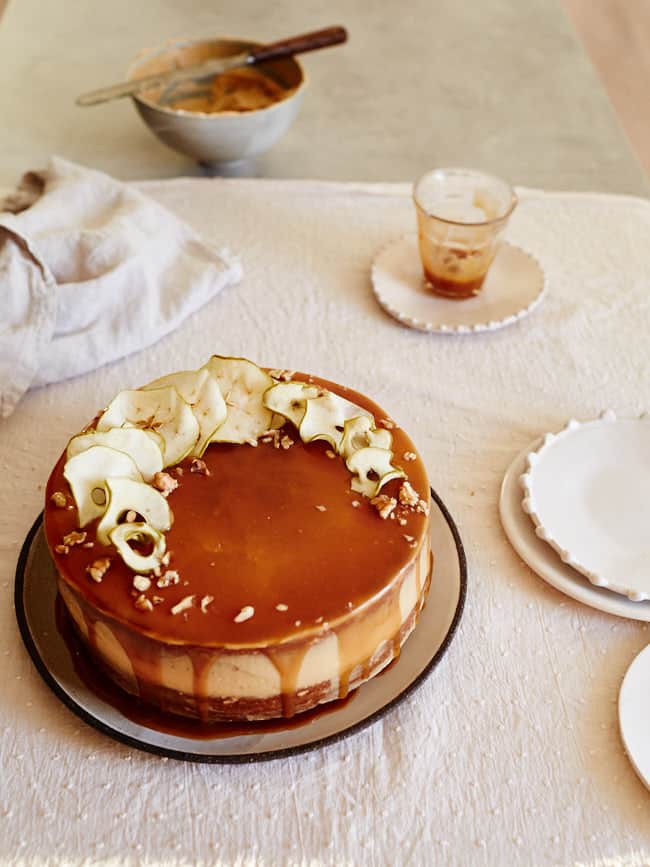
Salted Caramel Apple Cake

Thanks to OXO for sponsoring this post!

This Salted Caramel Apple Cake is a lovely autumn/winter bake, lightly spiced with cinnamon and covered with a brown sugar cream cheese frosting. 

I’ve been surprisingly busy since finishing uni, between the Ireland workshop and moving home I’ve been doing some freelance recipe development and photography. Meanwhile we haven’t had (and still don’t have) WiFi in the flat due to the building not being hooked up to the external phone lines so I’ve spent a lot of time on hold on the phone/waiting in for engineers. First world problems eh but it’s pretty critical to have internet for my work, unfortunately. Thank goodness for mobile hotspots!!! (i.e. the only way I can use my computer).

Food Blogger Izy Hossack makes Salted Caramel Apple Cake

I’ve also been lucky enough to have a few weeks here and there assisting the lovely Frankie on some book shoots. It’s actually been great to work in a team of people on a shoot and pick up some photography and styling tips along the way.

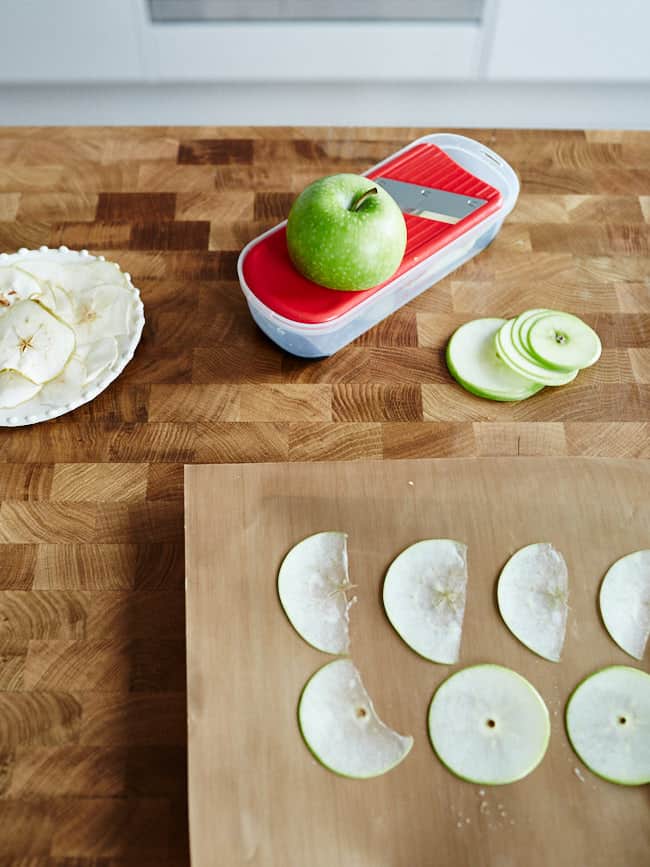
If you’ve ever been on a food shoot before you’d know that the food stylist always has a styling kit filled with random little tools like tiny spatulas and microplanes. One thing that’s pretty essential to have at all times is a mandolin for shaving veg for salads and decoration. I’ve got a large mandolin at home but the mini grate & slice set I used to make the apple chips for this cake (from OXO) is a very handy size to bring to shoots. It’s also got an interchangeable blade so you can use it as a small or large grater as well! The grater blades were sharp enough to zest the orange for the cake batter which is always something I look for in a grater.

Food Blogger Izy Hossack makes Salted Caramel Apple Cake

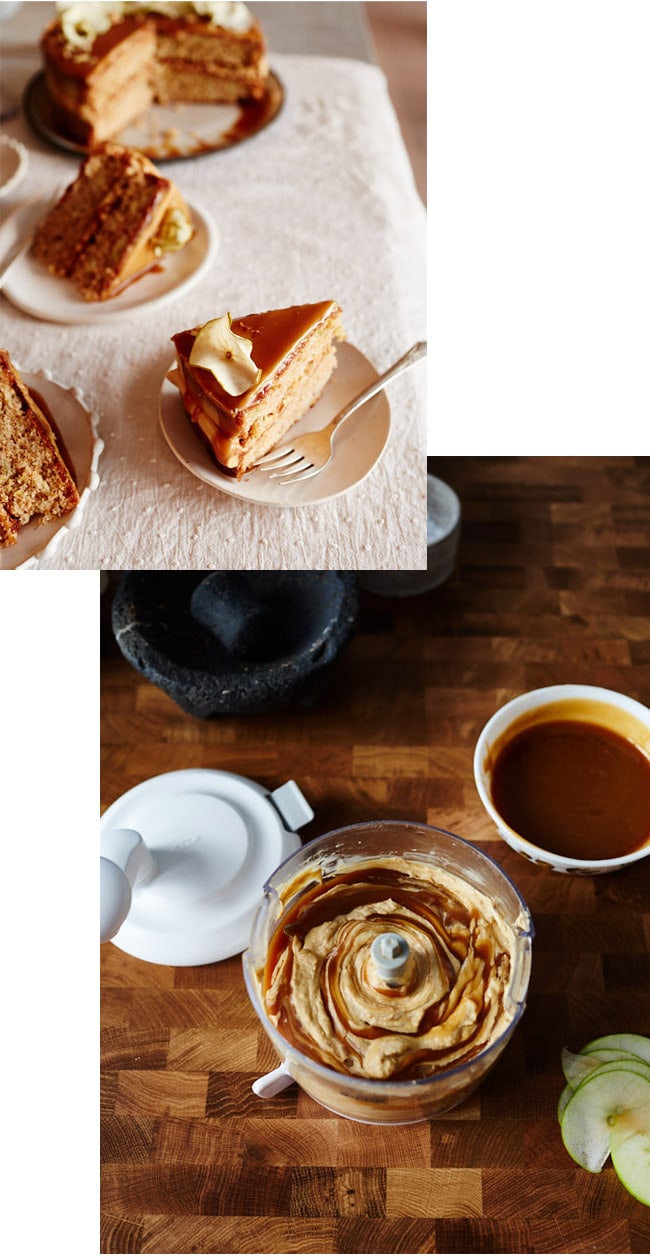
Another handy tool from OXO, which I could see being great to bring to shoots too, is their little one stop chop manual food processor. I used it here to make the buttercream and apple puree for the cake and its lightness means that I could easily carry it with me. Plus, I can just keep it on the shelves on my kitchen island to pull out for making a small batch of pesto, curry paste, salsa etc.

Food Blogger Izy Hossack makes Salted Caramel Apple Cake

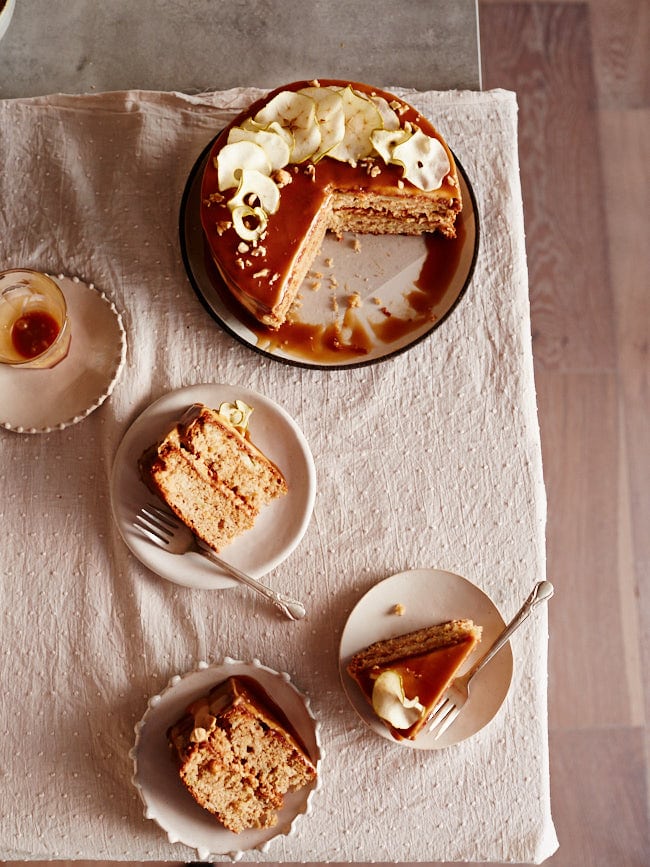
Now onto the cake – this is probably my favourite apple cake I’ve ever made. I whisked the eggs with the sugar until light and folded in a chunky apple puree. This not only added moisture like an applesauce would but little pieces of apple still studded the cake meaning pockets of appley goodness throughout. I made a cream cheese frosting for it, flavoured with muscovado sugar and salted caramel plus a drizzle of caramel sauce over the top. It’s a super light cake which actually doesn’t taste overly sweet in the end with a lovely warming flavour. I decorated with apple chips and a few crumbled walnuts but really, the cake is a showstopper even without the decorations. If you’re looking for an autumnal bake, this is *the one*. I hope you enjoy it!

Salted Caramel Apple Cake

For the cake:

  • 4 medium eating apples (peeled and cored)
  • 3 large eggs
  • 1 cup (200g) granulated sugar
  • 1 tsp ground cinnamon
  • 2 tsp baking powder
  • ½ tsp baking soda
  • ½ tsp salt
  • 2 1/2 cups (300g) plain flour
  • 3/4 cup (190ml) vegetable oil
  • 1 orange (zested)

For the Salted Caramel:

  • ½ cup (100g) granulated sugar
  • 2/3 cup (160ml) heavy cream
  • 2 tbsp unsalted butter
  • 1/2 tsp flaky salt

For the Frosting:

  • 10 oz (300g) cream cheese
  • 1/2 cup (100g) unsalted butter (very soft)
  • 1/2 cup (100g) dark brown sugar
  • ¼ cup (4 tbsp) salted caramel

For the cake:

  1. Preheat the oven to 180oC (350oF)/ 160oC convection. Grease and line two 8-inch (20cm) round cake tins. 

  2. Cut the peeled, cored apples into rough chunks and place into a medium pot. Add about 1/4 cup (60ml) of water to the pot and place over a medium heat on the stove. Once it starts to bubble, turn the heat down to medium-low and let it simmer for about 10 minutes until the apple chunks are soft. Tip away excess liquid in the pot. 

  3. Add cooked apples into the One Stop Chop and turn the handle a few times to roughly chop the apples into a chunky puree. You could also roughly mash the apples with a potato masher. Measure 1 cup (250g) of this puree out – that’s how much you’ll need.

  4. Crack the eggs into a large bowl. Using an electric whisk, beat the eggs, gradually streaming in the granulated sugar. Keep whisking until the mixture is thick, foamy and pale. 

  5. Add the 1 cup (250g) apple puree and remaining cake batter ingredients to the bowl of whisked eggs. Fold together with a spatula until just combined – try not to over-mix or you’ll knock all the air out. Divide the batter between the two prepared cake tins.

  6. Bake for 22-25 minutes or until a toothpick inserted into the centre of the cakes comes out clean. Let cool on a wire rack for 10 minutes before turning out of the tins and leaving to cool completely. 

For the caramel:

  1. Place the heavy cream and butter in a small pot over a low heat so that the butter melts and the cream starts to steam.

  2. Meanwhile heat the sugar in a light-coloured pan over a medium heat. Once the sugar starts to melt, start to tilt and swirl the pan so that the sugar mixes with the melted caramel and evenly melts. Once the sugar has all melted and has turned from light yellow to amber, turn the heat down to low and pour in the warm cream and butter mixture – this will bubble up so be careful. Stir together until smooth then take off the heat and stir in the salt. Let cool to lukewarm.

For the frosting:

  1. If you’re in the UK, the cream cheese first needs to be strained as it’s too wet. To do this, take 2 pieces of paper towel, stack them and place onto a cutting board. Tip away any excess liquid from the cream cheese container and scoop the cream cheese onto the paper towel. Top with 2 more pieces of paper towel. Press down to flatten the cream cheese out into a disk – this increases the surface area which allows more moisture to be blotted. Unpeel the top layers of paper towel and tip the cream cheese into a bowl, discarding the paper towel. 

  2. Cut the very soft butter into small cubes and place into the One Stop Chop with the brown sugar. Turn the handle until the mixture is smooth. Add the cream cheese and 1/4 cup (4 tbsp) of cooled caramel and turn the handle again until smooth. You could also make this by blending the ingredients together in a food processor until smooth. Chill until needed – you may need to whisk it slightly before using if it gets too firm in the fridge. 

To assemble the cake:

  1. Remove the baking paper from the cooled cakes. Place one cake layer onto a serving plate. Scoop a few heaped tablespoons of the frosting on top and use an offset spatula to smooth it out over the surface of the cake. Top with the second cake layer. Scoop a few more tablespoons of the frosting on top and frost the top and sides of the cake, using more frosting as needed – I like to go light on the frosting on the sides here as we’re pouring caramel on top too. 

  2. Once frosted, pour the remaining salted caramel you made earlier over the whole cake – if the caramel is too thick to pour at this point you can briefly warm it on the stove until it’s just slightly warm (if it’s too hot it’ll melt the buttercream). You can decorate the cake with apple chips if desired or leave it as is. 

Caramel: Place the heavy cream and butter in a small pot over a low heat so that the butter melts and the cream starts to steam. Meanwhile heat the sugar in a light-coloured pan over a medium heat. Once the sugar starts to melt start to tilt and swirl the pan so that the sugar mixes with the melted caramel and evenly melts. Once the sugar has all melted and has turned from light yellow to amber, turn the heat down to low and pour in the warm cream and butter mixture – this will bubble up so be careful. Stir together until smooth then take off the heat and stir in the salt. Let cool for 5 minutes then stir in the rum. Leave to cool completely. Bake 180C 22-25 min

The post Salted Caramel Apple Cake appeared first on Izy Hossack - Top With Cinnamon.


from Izy Hossack – Top With Cinnamon https://ift.tt/2F71Rkw

Friday, November 2, 2018

Galleria Concord Gardens

Galleria by Concord Pacific is a new transit community located at No.3 Road and Capstan Way in Richmond. This project in inspired by art and technology, and includes spa-inspired bathrooms, Miele appliances, and a unique art facility area for children. Located just steps away from a 2-acre neighbourhood park, Galleria brings contemporary living to a park-side setting. 

The post Galleria Concord Gardens appeared first on Vancouver New Condos.


from Projects – Vancouver New Condos https://ift.tt/2yQqAnt

Thursday, November 1, 2018

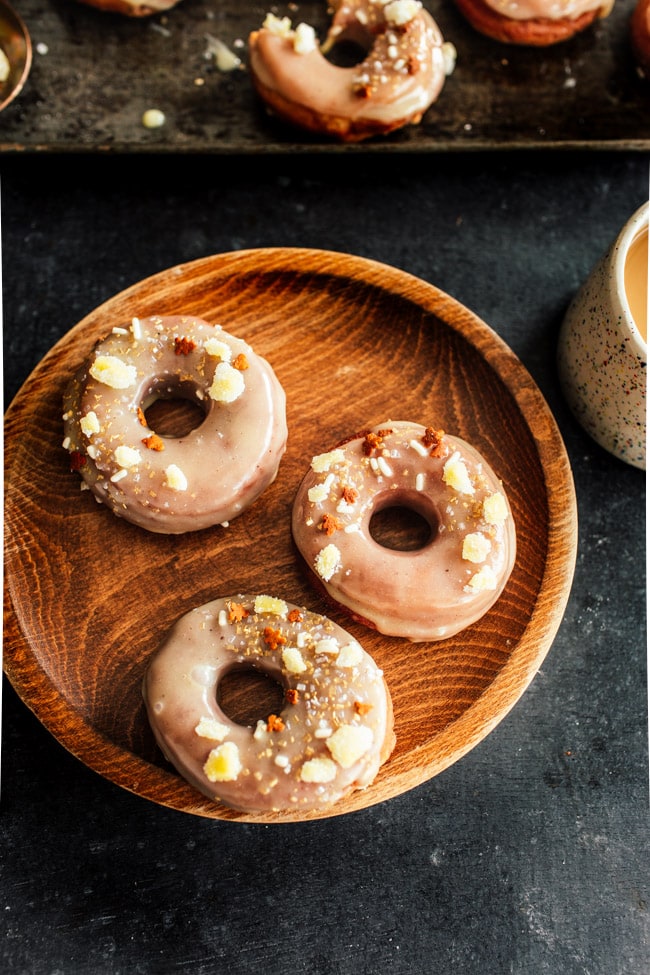
Gingerbread Doughnuts with White Chocolate Glaze

Gingerbread Doughnuts

I’ve never been much of a halloween dress up type person. For my whole life I’ve basically just winged making costumes at the last minute when I needed to. Luckily my mates from London are into a more chilled Halloween where we basically just eat snacks and watch some awful horror movies.

I made some gingerbread doughnuts with a simple white chocolate glaze to bring along with me for our Halloween movie viewing yesterday. I hadn’t made doughnuts in such a long time but had practiced last week for some recipe development I was doing. I was kind of dreading the process but you know what, they’re actually not bad to make. The frying only takes a few minutes so you’re not chained to the stove for ages making them.

Food Blogger Izy Hossack makes White Chocolate and Gingerbread Doughnuts

Let’s be real, the best part about doughnuts is always the toppings though. Going with the gingerbread doughnut theme I sprinkled on some little gingerbread man sprinkles and chunks of crystallised ginger – the sprinkles are deffo optional but I think the crystallised ginger was really what added a kick of flavour so I’d recommend keeping those on there! If you’re a white chocolate hater (I usually am but in glaze form it just tastes like vanilla) you can sub dark/milk chocolate instead as, if you’ve ever had chocolate and ginger, you’ll know it’s a killer combo!


Gingerbread Doughnuts with White Chocolate Glaze

makes ~14 doughnuts

  • 270 g (2 1/4 cups) plain white (all-purpose) flour
  • 4 tsp ground ginger
  • 1 tsp ground cinnamon
  • 1/4 tsp ground allspice
  • 1/8 tsp ground nutmeg
  • 1 tbsp granulated sugar
  • 1/2 tsp salt
  • 2 1/4 tsp instant yeast (easy bake yeast)
  • 1 tbsp vegetable oil (plus more for frying)
  • 1 large egg
  • 70 g (1/4 cup + 2 tsp) warm milk
  • 70 g (1/4 cup + 2 tsp) water

White chocolate glaze:

  • 3 tbsp milk
  • 200 g (7 oz) good quality white chocolate (I use Green & Black's)
  • 2 tbsp crystallised ginger, chopped into small chunks if large
  • 2 tbsp sprinkles, optional
  1. Place the flour, spices, sugar and salt in the bowl of a stand mixer. Briefly mix together. Add the yeast, the 1 tbsp of vegetable oil, egg, milk and water. Using the stand mixer fitted with the dough hook, knead the dough for 6-8 minutes until smooth and elastic. 

  2. Pour a little extra oil into the bowl, lift up the dough and then flip it over to coat with oil. Cover with a damp cloth and leave somewhere warm until doubled in volume. 

  3. Tip the risen dough out onto a work surface dusted with flour. Punch it down and then roll it out to be able 5mm (1/4-inch) thick. Using a 7cm (3-inch) round cutter or glass, stamp out circles of dough. Use the back end of a pastry tip to cut out circles from the centre of the dough. Re-roll the scraps and cut out remaining doughnuts.

  4. Place the cut doughnuts onto a baking sheet dusted with flour. Cover with a damp cloth and leave somewhere warm for 30 minutes to rise again. 

  5. Heat about a 3cm (1-inch) depth of vegetable oil in a deep frying pan to 180oC (350oF).

  6. Gently lower the doughnuts into the oil, a few at a time, and let fry until golden underneath. Flip and fry on the other side until golden. This will only take 1-2 minutes on each side. Remove to a baking tray lined with paper towels to drain excess oil. 

Make the glaze:

  1. In a small pot place the white chocolate and milk over a low heat. Constantly stir the mixture to prevent it burning until all the white chocolate has melted and you have a thick, glossy glaze. It needs to be warm to be thin enough for dunking so re-warm if it’s getting too thick. 

  2. Dunk the fried doughnuts into the glaze and set glazed side up on a wire rack set over a baking tray (to catch excess glaze). Sprinkle with the crystallised ginger and any sprinkles you want. Leave to set. 

The post Gingerbread Doughnuts with White Chocolate Glaze appeared first on Izy Hossack - Top With Cinnamon.


from Izy Hossack – Top With Cinnamon https://ift.tt/2AFruV3